

Hydration Journal
What Are Electrolytes and Why Does Your Body Need Them?

You drink water all day. You're doing the right thing — or so you think. But then a muscle cramp seizes your calf at 2 a.m., or your brain turns to static around 3 p.m. even though you've had nothing but water and coffee, or you finish a long run and feel worse than when you started. More water doesn't fix it. That's because dehydration and electrolyte imbalance are two different problems, and most people treat them like they're the same thing. What you're experiencing — that specific combination of fatigue, fog, and muscle misfires — has a name. Understanding what electrolytes actually are makes the fix fairly obvious.
What Electrolytes Actually Are
An electrolyte is a mineral that carries an electrical charge when dissolved in water. That's the whole definition. Sodium, potassium, magnesium, calcium, chloride, zinc, iron — when these minerals dissolve in fluid, they break apart into ions with a positive or negative charge. That charge is what makes them fundamentally different from other nutrients your body uses.
Your body is not a chemistry set at rest. It's a system of continuous electrical activity — nerve signals firing, muscles contracting and releasing, fluids shifting in and out of cells billions of times a day. Electrolytes are the medium that makes all of that possible. Without the right concentration of charged ions, the electrical signals slow, misfire, or stop.
The Five You've Probably Heard Of
Sodium is the primary electrolyte in your blood and the fluid surrounding your cells. It controls fluid balance, helps transmit nerve signals, and is the mineral you lose most of when you sweat — which is why sweat tastes salty. The body monitors sodium tightly and will retain water or trigger thirst to keep concentrations stable.
Potassium works in direct opposition to sodium inside your cells. The sodium-potassium pump — one of the most studied mechanisms in cell biology — moves three sodium ions out and two potassium ions in with every cycle, powered by ATP. This gradient drives nerve impulses and muscle contractions throughout your body. The recommended daily intake for potassium is 4,700mg. The average American gets about 2,500mg. That gap — nearly 2,200mg every single day — is one of the main reasons so many people feel chronically flat and crampy without a clear explanation.
Magnesium participates in more than 300 enzymatic reactions, including energy production, protein synthesis, and every phase of muscle function — both contraction and, critically, relaxation. Magnesium is also required to activate B-vitamins, so a deficiency compounds everything downstream. It's the most common mineral deficiency in the United States, which tracks with the epidemic of poor sleep, persistent muscle tension, and afternoon energy crashes people have largely accepted as normal.
Calcium is reflexively associated with bones, but its more immediate job is triggering muscle contractions — including in your heart. Calcium and magnesium work as a paired system: calcium contracts, magnesium releases. When these two are out of balance, you get the muscle hyperexcitability behind cramps, spasms, and that clenched-jaw tension.
Chloride works alongside sodium in virtually everything sodium does — fluid balance, acid-base regulation, and sweat composition. Sweat isn't just sodium; it's sodium chloride. Replacing one without the other is a partial replacement.
The Two Most People Don't Know Are Electrolytes
Zinc participates in DNA synthesis, wound healing, and cellular repair under oxidative stress. During illness — particularly with fever — zinc losses accelerate fast, which is part of why recovery feels so depleting.
Iron is responsible for oxygen transport. Hemoglobin, the protein in red blood cells, requires iron to carry oxygen. When iron is low, your blood delivers less oxygen per unit of volume. Your muscles, brain, and organs work under a reduced oxygen supply even when you're breathing normally and hydrating well. Iron-deficient people are often told they're just tired. The real issue is that their oxygen delivery system is running below capacity.
Trace Minerals: The Layer No One Talks About
Below the seven major electrolytes is a layer of minerals present in much smaller amounts — boron, manganese, chromium, selenium, and dozens of others. The body needs them in tiny quantities, but they play real roles in cellular communication, enzyme activation, and metabolic signaling. They used to come from soil and groundwater. Modern water filtration and industrial farming have steadily removed them from both sources. Most people haven't consciously lost these minerals — they were quietly stripped out of the food and water supply long before most of us were paying attention.
How Electrolytes Work at the Cellular Level
The sodium-potassium pump runs in every cell, all the time. It maintains the charge difference across the cell membrane — the membrane potential — that makes electrical signaling possible. When a nerve fires, sodium rushes in and potassium rushes out, producing an action potential: the electrical impulse behind every thought, muscle movement, and heartbeat. The pump then restores the gradient so the cell can fire again. When electrolyte levels drop, the pump can't maintain that gradient. Signals slow. Muscles misfire. Your brain starts to feel like a computer running out of memory.
How You Lose Electrolytes
Sweat is the most obvious route — a typical hour of moderate exercise produces around 1 liter of sweat containing 500–1,000mg of sodium and proportional amounts of other minerals. Urination is a continuous low-level loss that compounds fast when you're drinking large amounts of plain water without replacing what the kidneys filter out.
Illness dumps electrolytes rapidly through vomiting and diarrhea, which is why clinical dehydration treatment uses mineral-balanced oral rehydration solutions — not plain water. And certain medications deplete electrolytes in ways patients are rarely warned about: diuretics wash out sodium and potassium by design; metformin affects magnesium and B12; GLP-1 agonists reduce appetite in ways that can quietly cut mineral intake alongside food volume.
What Electrolyte Imbalance Actually Feels Like
Mild deficiency rarely announces itself. It shows up as muscle cramps (especially at night), headaches that water doesn't touch, brain fog, fatigue, irritability, or general flatness — the sense of running at 80% without knowing why. Severe imbalance, particularly with very low sodium or potassium, can cause irregular heartbeat and requires medical attention. But most people never reach that point. They just spend years slightly below where they should be, treating it as a personality trait rather than a physiology problem.
The Gap Most People Never Think About
There's a cleaner way to hydrate.
Try VitaWild — Save 55% TodayFree shipping · 30-day money-back guarantee · Cancel anytime
Here's the common scenario: someone decides to take electrolytes seriously, picks up a product, feels marginally better, and assumes the job is done. But most electrolyte products on the market contain two or three minerals — typically sodium and potassium, sometimes magnesium. That covers part of the system. The rest — chloride, calcium, zinc, iron, the trace mineral layer — is left empty.
The question worth asking before you commit to any product: does this cover the full spectrum, or just the minerals with the most marketing behind them?
What a Complete Electrolyte Profile Actually Looks Like

Reading an electrolyte label critically is a skill worth developing.
Gatorade has sodium and potassium — plus enough sugar to crowd out more useful ingredients. LMNT, popular with endurance athletes and people eating low-carb, has sodium, potassium, and magnesium in solid amounts. It's a meaningful step up. But it stops there: no vitamins, no calcium, no chloride, no trace minerals. Most budget powders and tablets follow the same two-mineral pattern, just without the sugar.
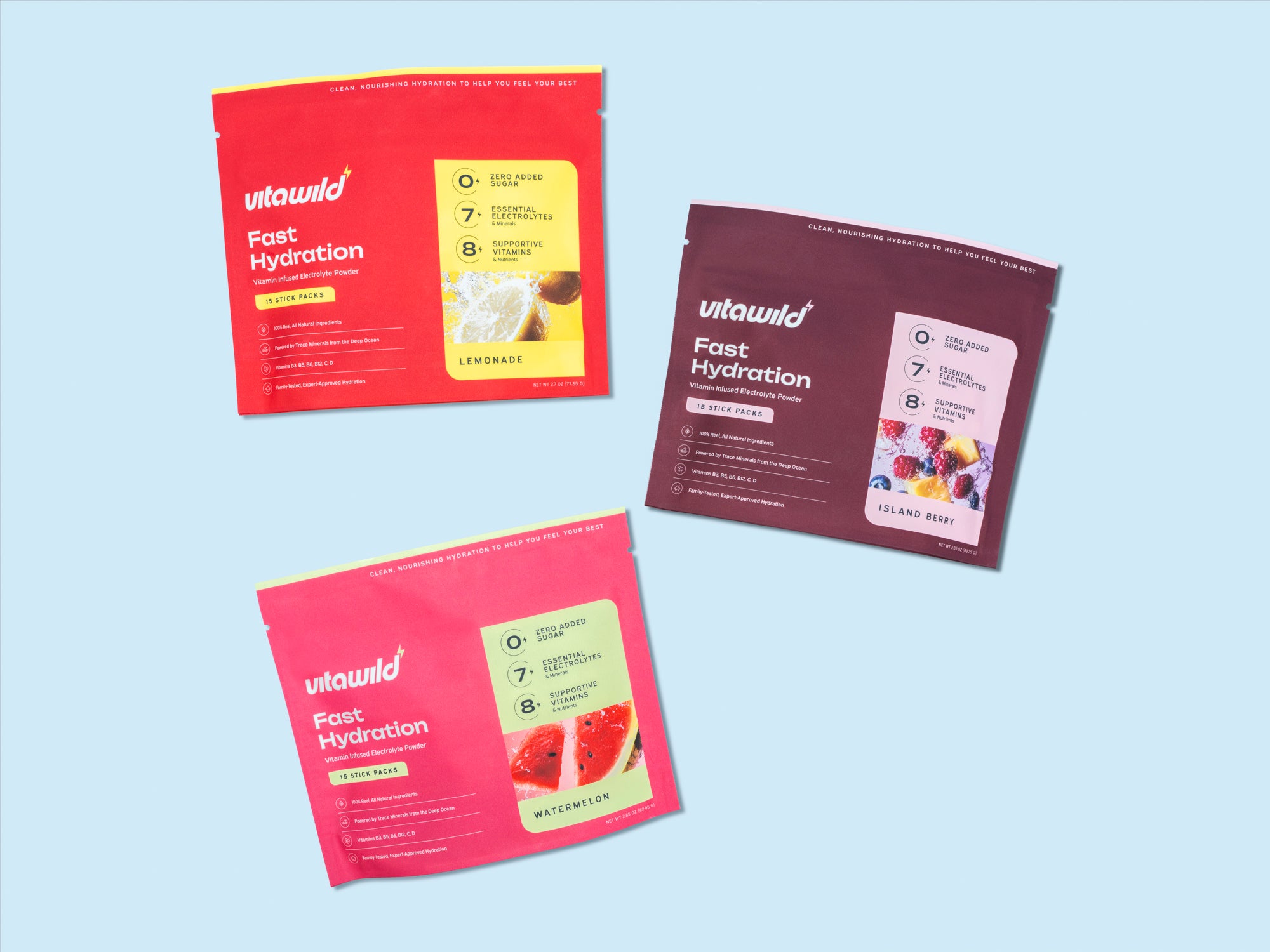
A complete profile looks like what VitaWild is built around: all 7 electrolytes — Sodium 450mg, Potassium 800mg (as potassium citrate for bioavailability), Chloride 740mg, Magnesium 75mg (as magnesium citrate), Calcium 80mg (from calcium lactate and Aquamin® F, sourced from Icelandic red algae), Zinc 3mg, and Iron — alongside 8 vitamins including Vitamin C 300mg, Vitamin D 60mcg, and the full B-complex, plus 84+ ionic trace minerals from ConcenTrace®, drawn from Utah's ancient sea bed. Zero added sugar. All-natural. Non-GMO. That's what the full picture looks like.
Whatever you choose: check for at least sodium, potassium, and magnesium, and make sure potassium is at least 600mg. Most people are running that 2,200mg daily deficit, and a 100mg dose barely moves the needle. If magnesium isn't listed as citrate, glycinate, or malate, absorption is likely lower than the label implies. And if there's no chloride, calcium, or trace minerals, you're covering roughly 40% of the electrolyte equation.
VitaWild was built to close the remaining 60%.
The Only Thing Worth Remembering
Electrolytes are not a wellness trend. They're the infrastructure your cells run on — the literal medium of nerve signals and muscle function. The science is not new or contested. What's new is that the food supply, water supply, and modern health conditions have combined to make it genuinely hard to maintain adequate levels through diet alone.
If you take nothing else from this: potassium and magnesium. Those are the two most people are consistently short on, the two with the widest gap between what's recommended and what's actually consumed, and the two that produce the most noticeable shift when you get them right. Start there. Everything else builds on that foundation.
Ready to feel the difference?
Try VitaWild — Save 55% TodayFree shipping · 30-day money-back guarantee · Cancel anytime


