

Hydration Journal
Sugar in Electrolyte Drinks: How Much Is Too Much?

Edited October 6, 2026
You're standing in the sports nutrition aisle, squinting at a label on something that calls itself "Advanced Hydration Formula." It has a swooping logo, an athlete on the packaging, and the word "electrolyte" printed in bold. You flip it over. Thirty-six grams of sugar per bottle. That's more than a Snickers bar.
This happens every single day in grocery stores across the country. We reach for something that reads like medicine — sodium, potassium, replenishment — and walk away with a product that's mostly sweetened water. The gap between what electrolyte drinks promise and what they actually deliver is wide enough to drive a truck through. And it starts with the sugar.
Why Sugar Got Into Sports Drinks in the First Place
The original case for sugar in sports drinks is actually solid science. When researchers developed the early Gatorade formula in the 1960s, they built it around a concept called the sodium-glucose co-transport mechanism. Simplified: glucose (sugar) actively pulls sodium across the intestinal wall, which accelerates fluid absorption. It's not marketing spin — it's physiology. Adding sugar genuinely helps the body absorb water and electrolytes faster than plain water alone.
The problem isn't the science. It's who the science was designed for.
The original Gatorade formula was engineered for University of Florida football players practicing in brutal summer heat, burning anywhere from 3,000 to 5,000 calories per training session. Their bodies were depleted in ways that demanded rapid reloading of both fuel and minerals. The formula made sense for them.
It does not necessarily make sense for an office worker doing a 45-minute spin class, a kid at soccer practice, or someone who just wants to stay hydrated on a hot afternoon without collapsing their glycemic balance.
Traditional sports drinks (Gatorade, Powerade)
A 12-ounce serving of Gatorade contains 21 grams of sugar. A full 32-ounce bottle — the size sold at most convenience stores — contains roughly 56 grams. For a person doing moderate exercise, that sugar load isn't replenishing depleted glycogen; it's just extra glucose hitting the bloodstream. These drinks also contain artificial dyes like Red 40 and Yellow 5, which have faced growing scrutiny from regulators and consumer advocacy groups. If you're running a marathon, a Gatorade is defensible. If you're doing anything less than an hour of intense output, the math doesn't work in your favor.
"Health" hydration brands (Liquid IV, similar)
Liquid IV markets itself aggressively on the science of oral rehydration — specifically, that cellular transport mechanism — and the science isn't wrong. But 11 grams of sugar per serving is still 11 grams of sugar. For people trying to manage blood sugar, reduce caloric intake, or avoid the insulin response that follows a sugar spike, this is a real tradeoff, not a minor footnote.
Natural options (coconut water)
Coconut water has a genuine case to make. It's a natural source of potassium, it contains no artificial anything, and the sugar it carries — roughly 9 to 11 grams per cup depending on brand and variety — is inherent to the fruit. For people who respond better to whole-food sources, this is a reasonable choice. The limitation is that coconut water typically delivers much lower sodium than most people lose in sweat, and the sugar content is still a real number on a real label.
The sugar alcohol problem
A segment of the market responded to sugar concerns by eliminating sugar entirely — then replacing it with sugar alcohols like sorbitol or maltitol. These show up most commonly in brands positioning themselves as "low sugar" or "clean." The issue is that sugar alcohols are not digested in the small intestine; they travel to the large intestine where gut bacteria ferment them. For many people, this produces bloating, cramping, and GI distress — the last thing you want when you're already exercising or recovering. If you see sorbitol, maltitol, xylitol, or erythritol on a label, know that your tolerance for these compounds is individual. Some people handle them fine. Others very much do not.
The artificial sweetener question
Sucralose and acesulfame potassium (acesulfame-K) appear in a large number of zero-calorie hydration products. Both are FDA-approved and widely used. Both also generate consistent consumer complaints about headaches and gut sensitivity, particularly with frequent use. The emerging research on artificial sweeteners and gut microbiome is still developing, but it's not a stretch to say that the picture is not entirely clean. These ingredients are not ideal for children, and adults with sensitive systems often report problems they don't connect to the sweetener until they switch products.
Natural sweeteners: the stevia case
Stevia is derived from the Stevia rebaudiana plant and has been used as a sweetener in South America for centuries. It produces no insulin response, has no known GI effects at normal use levels, and leaves no synthetic chemistry in your body. It does have a flavor profile — slightly herbal, with a faint bitterness at high concentrations — that has improved dramatically as extraction and formulation techniques have advanced. For most people, well-formulated stevia-sweetened products taste close enough to sugar-sweetened that the difference is negligible.
What you actually need from an electrolyte drink
The minerals matter: sodium, potassium, magnesium, and a few others that support nerve function, muscle contraction, and fluid balance. The sugar is a delivery vehicle — one that was added because it helped absorption, but is not itself the payload. A well-formulated electrolyte product can deliver those minerals effectively without sugar, as long as the sodium and potassium concentrations are meaningful. Watch for this: many low-sugar or zero-sugar products dramatically cut the mineral content too. A product with 100mg of sodium and 50mg of potassium is not doing much for you regardless of its sugar count.
When sugar genuinely makes sense
For ultra-endurance events — marathons, triathlons, century rides, extended hikes — the calculus shifts. When you're exercising at moderate-to-high intensity for more than 90 minutes, your body burns through glycogen stores and actively needs carbohydrate fuel alongside electrolytes. In that context, a product with some sugar is not a compromise; it's appropriate fueling. The error is applying marathon nutrition logic to everyday hydration.
Reading the label: what to look for
Check total sugars and added sugars — they're listed separately on current nutrition labels. Look at sodium (anything below 200mg per serving is underwhelming for a sports drink), potassium (meaningful amounts start around 200-300mg), and the sweetener list. If the sweetener section includes multiple unfamiliar chemical names, that's a signal. The ingredient list is ordered by weight — whatever's first is the most abundant. If sugar or a syrup variant is in the first three ingredients of an "electrolyte drink," you're mostly buying flavored sugar water with trace minerals.
The Electrolyte-Sugar Illusion
There's a cleaner way to hydrate.
Try VitaWild — Save 55% TodayFree shipping · 90-day money-back guarantee · Cancel anytime
The market has done a remarkably effective job of merging two ideas: "electrolyte drink" and "contains sugar." They've been packaged together so long that many people assume the sugar is the point, or at least the price of admission. It isn't. The minerals are the point. The sugar was always optional — useful in specific contexts, unnecessary or counterproductive in most others. The real question, once you clear the sugar, is what a product uses to make it palatable to drink.
The Zero-Sugar Electrolyte Landscape
Here's an honest look at what's actually available if you want zero or near-zero sugar.
LMNT
LMNT contains no sugar and no sweetener of any kind — just sodium (1,000mg), potassium (200mg), and magnesium (60mg) in a salty, slightly mineralic packet. It works extremely well for people adapted to a high-sodium diet or those following ketogenic protocols who want aggressive electrolyte replacement. The consistent feedback from people who don't enjoy it is straightforward: it tastes very, very salty, and many people find it difficult to drink consistently, especially in warmer flavors. If you're salt-tolerant and want the purest electrolyte hit possible, LMNT is worth trying.
Nuun Sport
Nuun Sport tabs have just 1 gram of sugar, which sounds excellent until you read further and find sorbitol on the ingredient list. Nuun works well for plenty of people — it's convenient, the tablet format is easy to carry, and the flavor selection is solid. But if your stomach is sensitive, the sorbitol can create problems, particularly when you're active. Worth knowing before you commit to a case.
Liquid IV
Liquid IV delivers 11 grams of sugar per serving alongside a genuine electrolyte blend. It's not a bad product — the sodium-glucose transport science behind it is real, and it absorbs quickly. For people who have no sugar concerns and want a reliable, fast-absorbing option, it's a reasonable choice. It's just not zero-sugar, and if that's what you're looking for, the label will tell you clearly.
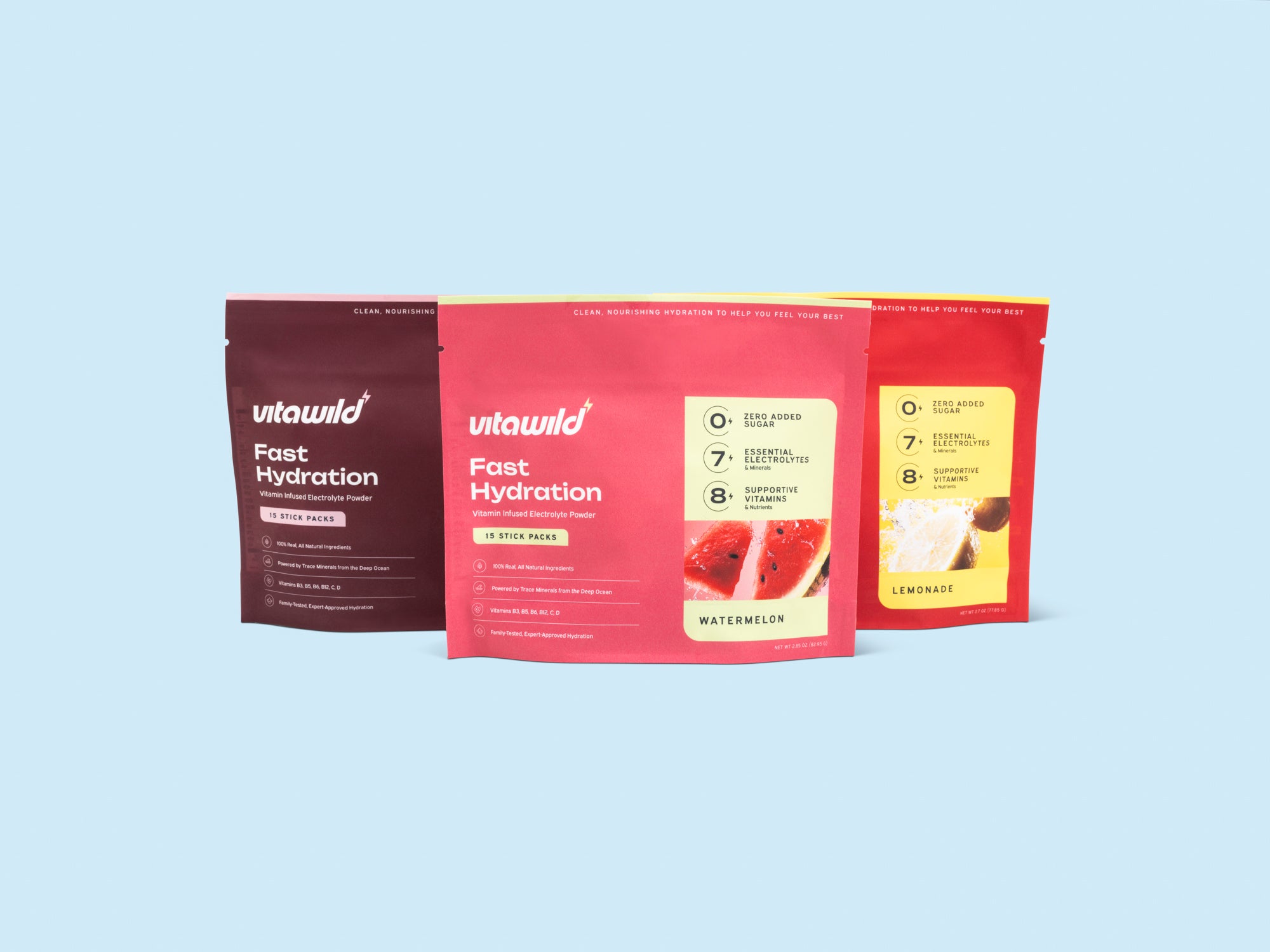
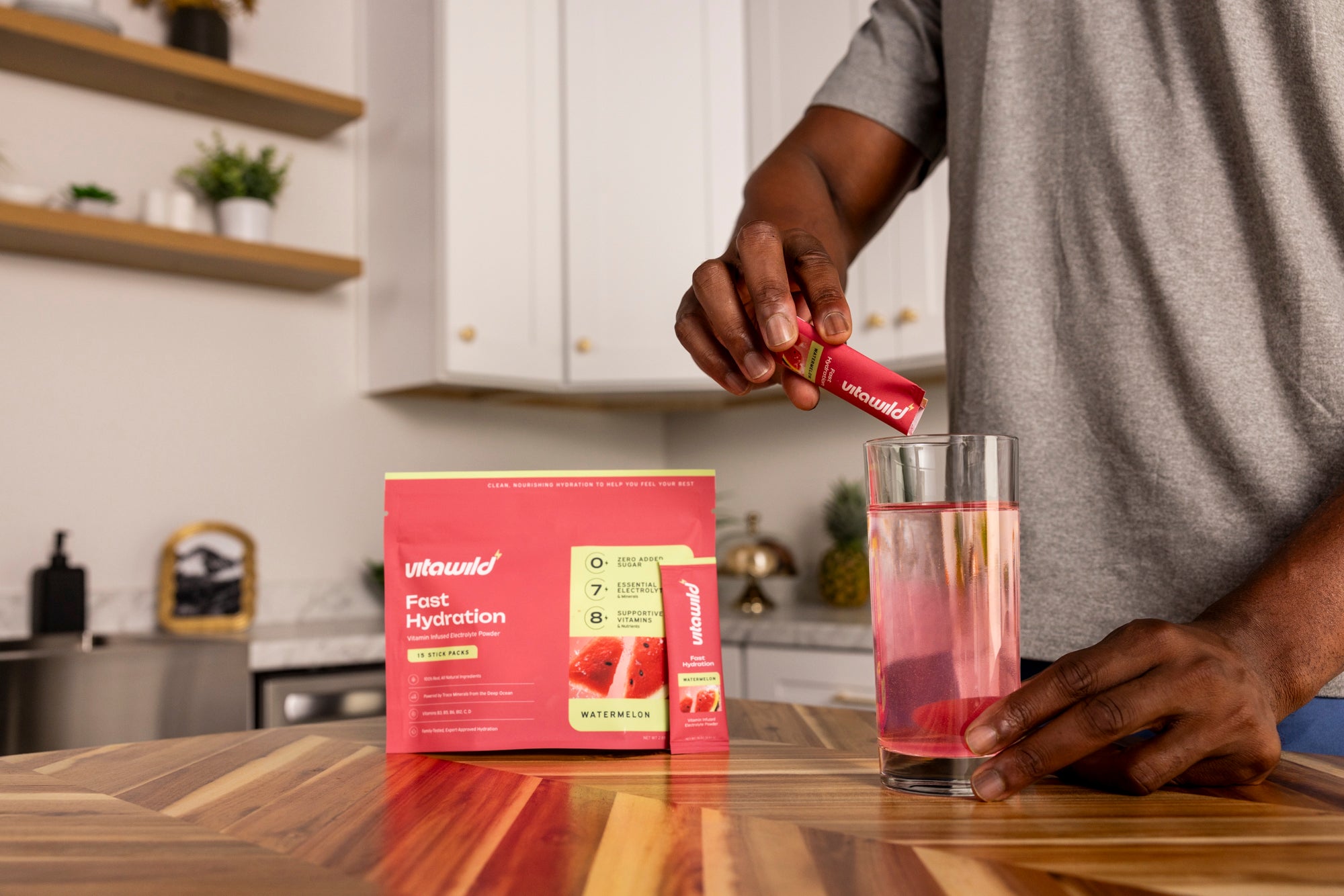
VitaWild contains 0 grams of added sugar and no artificial sweeteners — no sugar alcohols, no sucralose, no acesulfame-K. The electrolyte profile is substantive: 450mg sodium, 800mg potassium, and seven electrolyte and mineral sources in total. There are no artificial colors or artificial flavors. The flavors — Lemonade, Island Berry, and Watermelon — are designed to be drinkable by kids and adults alike, which matters if you're buying one product for a household. VitaWild is the option for people who want genuine mineral content, a clean sweetener, and no having to choose between tasting good and reading clean on a label. It's not the right pick if you want a zero-sweetener product like LMNT, but for anyone who wants flavor without the sugar compromise, the formulation is hard to argue with.
The Takeaway
Reading a nutrition label takes about 30 seconds. Check total sugars, check the sweetener, check the sodium and potassium numbers. Sugar in an electrolyte drink isn't automatically bad — for high-output endurance exercise, it genuinely helps. But most people consuming these products are not running marathons. They're staying hydrated through a workday, a workout, a hot afternoon. For them, the 21 grams of sugar in a standard sports drink is extra, not necessary.
Look for meaningful electrolyte content (sodium in the hundreds of milligrams, potassium ideally above 300mg), a sweetener you're comfortable with, and a short ingredient list. The drink that does its job quietly, without the sugar burden, is out there. You just have to flip the label over first.
Ready to feel the difference?
Try VitaWild — Save 55% TodayFree shipping · 90-day money-back guarantee · Cancel anytime


