

Hydration Journal
Perimenopause and Dehydration: Why Your Body's Rules Are Changing

Edited October 5, 2026
You wake up at 3 a.m. with the sheets damp and your heart tapping a little faster than it should. You're not sick. You haven't changed anything. But something has shifted — and the answers you're getting range from "that's normal" to a prescription you're not sure you want. Meanwhile you're exhausted in a way sleep doesn't fix, you're retaining water one day and desperately thirsty the next, and your brain keeps losing the thread mid-sentence. Nobody told you this was coming. Nobody told you it would feel like this.
If any of that lands, you're not imagining it. Perimenopause changes the rules of how your body works — and hydration is one of the first systems to feel it.
What's Actually Happening in Perimenopause
Perimenopause is the transition phase before menopause, and it can last four to ten years. It typically begins in the early-to-mid 40s, ending twelve months after your last period. Estrogen and progesterone don't drop in a clean, predictable line — they surge, crash, and fluctuate in patterns unique to each woman, which is part of why the experience feels so disorienting.
Estrogen doesn't just govern reproductive function. It plays a significant role in fluid regulation through its influence on aldosterone — the hormone that signals your kidneys to retain sodium and water. When estrogen fluctuates, so does fluid balance. You may feel bloated after meals that never caused that before, thirsty despite drinking plenty, or both within the same afternoon. It's your body responding to a moving hormonal target, not a failure of willpower or routine.
Night Sweats Are More Than Uncomfortable
Hot flashes and night sweats affect roughly 75% of women in perimenopause. What's less discussed is what a night sweat actually does to the body. A meaningful one — the kind that soaks your shirt — depletes sodium, potassium, and magnesium at rates comparable to moderate exercise. Waking up after a night sweat is physiologically similar to waking up after a workout you didn't do, in a body already under hormonal stress. Most women reach for water alone when they're thirsty in those early hours, which doesn't replace what was lost.
Some research suggests magnesium supplementation may help reduce the frequency and severity of hot flashes. The mechanism involves magnesium's role in serotonin receptor function and thermoregulation pathways. The evidence is early — "may help" is the right framing, not "treats" — but the connection makes physiological sense, and magnesium is a nutrient many women are already deficient in before perimenopause begins.
Bone Density: The Long-Term Conversation
Estrogen slowed bone resorption throughout your 30s and early 40s. As it declines in perimenopause, that protection diminishes and resorption accelerates. Calcium and Vitamin D are the standard recommendations — and they matter. But Vitamin D requires magnesium to convert to its active hormonal form. Without adequate magnesium, supplementing Vitamin D may not deliver the bone-support benefits you're expecting. This piece is frequently left out of the conversation, despite roughly 48% of Americans consuming less magnesium than their bodies need. Vitamin D deficiency is also common and often untested in perimenopausal women. Many functional medicine practitioners recommend a target of 40–60 ng/mL; it's worth requesting a level if you haven't had one recently.
Heart Palpitations and the Electrolyte Connection
Heart palpitations — a fluttering, skipping, or racing sensation — are a frequently underacknowledged perimenopausal symptom. They're understandably alarming, and a conversation with your doctor to rule out anything cardiac is always the right first step. That said, in the absence of structural issues, perimenopausal palpitations are often benign and are frequently worsened by electrolyte imbalance, particularly low potassium and magnesium. Both minerals support the electrical signaling that keeps heart rhythm steady. Consistent replenishment may help some women notice a reduction in frequency — but check with your doctor first.
Brain Fog, Energy, and the Hormonal Shift
There's a cleaner way to hydrate.
Try VitaWild — Save 55% TodayFree shipping · 90-day money-back guarantee · Cancel anytime
Estrogen supported the production of dopamine and serotonin. As it fluctuates, so does that support. Many women describe a cognitive static: losing words mid-sentence, forgetting what they walked into a room for, struggling to hold a train of thought. B vitamins — particularly B6 and B12 — play a direct role in neurotransmitter synthesis. Choline supports acetylcholine production, which underpins memory and cognitive processing. During perimenopause, when your brain is navigating hormonal changes, maintaining adequate B vitamins and choline is a practical way to support the system under pressure.
The Sugar and Weight Connection
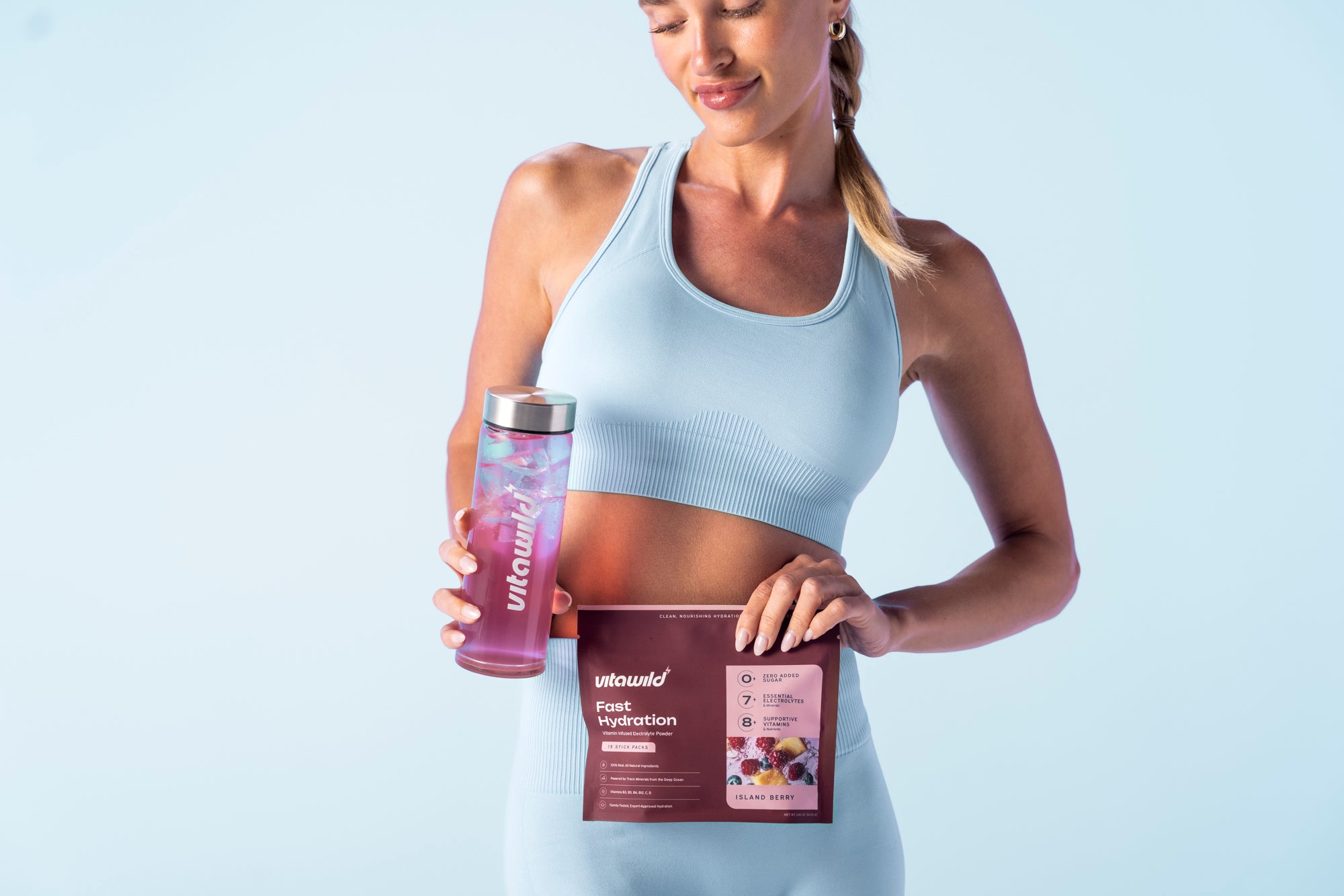
Perimenopause affects insulin sensitivity. Hormonal fluctuations can alter how your body processes glucose, and high-sugar drinks — even "healthy" electrolyte options — may worsen the metabolic responses that are already shifting. Weight redistribution toward the midsection during perimenopause is partly driven by this change, not just lifestyle factors. The source of your hydration matters more than it did a decade ago.
What Consistently Helps
The women who navigate perimenopause's hydration challenges most effectively aren't doing anything dramatic. They're being consistent: drinking throughout the day in steady amounts rather than catching up in the evening, taking electrolytes with meals, replenishing minerals in the morning after a night sweat before reaching for coffee, and considering magnesium in the evening for sleep and muscle relaxation. Alcohol and caffeine are meaningful dehydration amplifiers during this phase. They don't need to be eliminated, but their effect on fluid balance is greater now than it was before. Working with an OB-GYN or functional medicine doctor on a full hormone panel gives you a concrete baseline to build any strategy from.
The Moving Target Problem
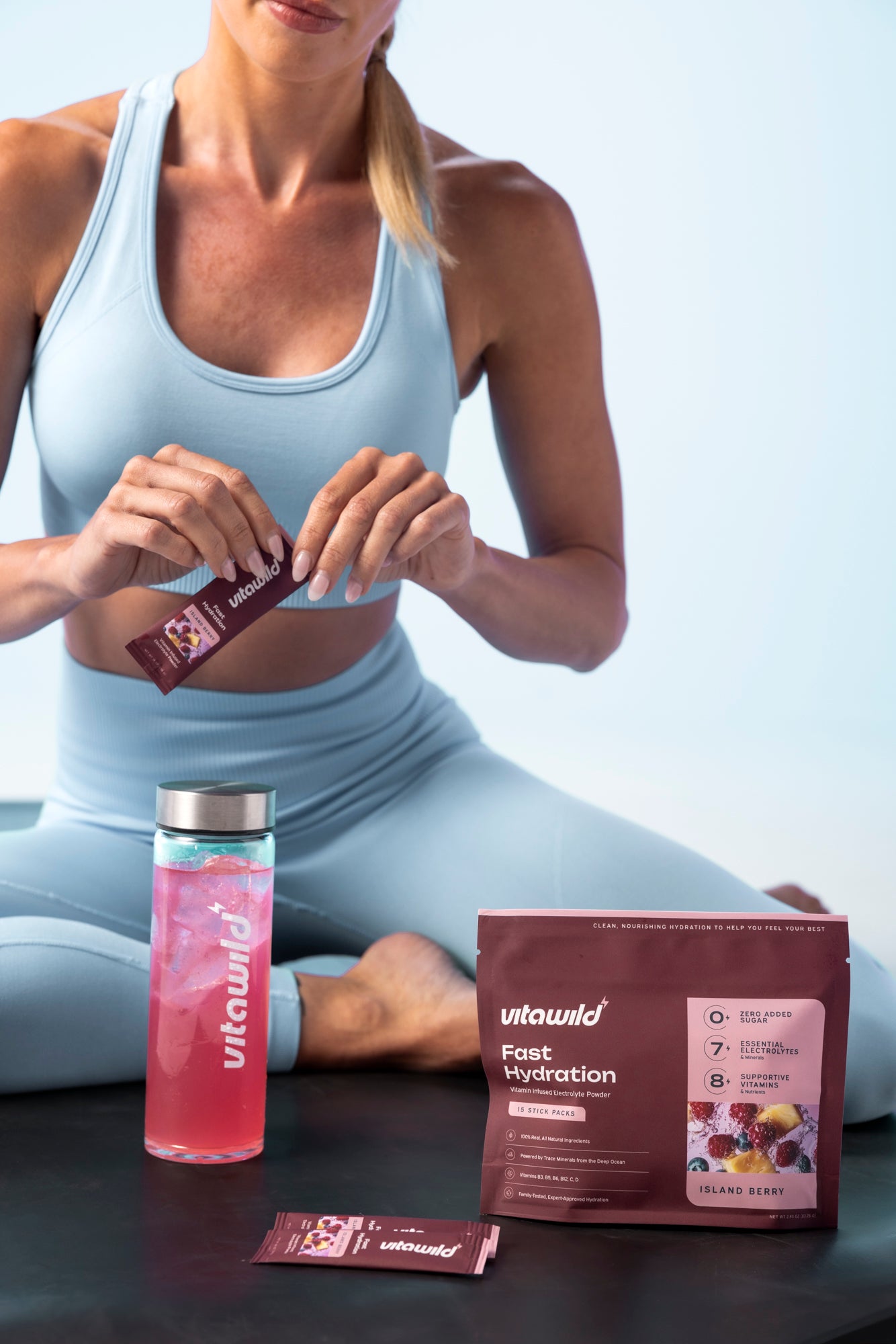
The challenge with perimenopause is that it doesn't hold still. A hydration routine that worked well at 38 may feel inadequate at 44 — not because you've stopped following through, but because the hormonal landscape has shifted again. Adapting alongside the transition, rather than assuming one approach covers the whole arc, is the more realistic frame.
Building a Perimenopause-Friendly Hydration Routine
The practical version of all of this is a daily baseline that addresses perimenopause's specific demands — not just general hydration, but targeted mineral replenishment timed to when you need it most.
Start your morning with electrolytes before your first coffee. If you had a night sweat, your body woke up depleted in sodium, potassium, and magnesium. VitaWild is built for this kind of daily-use support: 800mg potassium citrate for steady muscle function and heart rhythm, 80mg magnesium from magnesium citrate and the trace mineral complex that may support muscle relaxation and sleep quality, 2,400 IU Vitamin D (60mcg) for bone support and mood, Aquamin® F marine-sourced calcium for bone density, 300mg Vitamin C for collagen support as skin changes occur, and a B-complex with 60mg choline for energy and cognitive function. It contains 0g added sugar — no metabolic interference for the insulin sensitivity changes perimenopause brings. One stick provides the most relevant nutrient combination for this life stage in a single, convenient format.
For the evening, a dedicated magnesium supplement like Natural Calm (magnesium glycinate or citrate) before bed may provide additional support for sleep and muscle relaxation beyond the morning routine. Vitamin D testing — with a goal of reaching 40–60 ng/mL — is worth building into your annual bloodwork. And a full hormone panel through your OB or a functional medicine practitioner will give you far more specific guidance than any general routine can offer.
Think of VitaWild as a daily baseline, not a treatment. It covers the nutritional ground that perimenopause consistently erodes, so your body has what it needs to do its work.
You're Not Falling Apart
Perimenopause is a transition, not a diagnosis. It's a decade-long biological shift that affects nearly every system, and most women move through it with almost no preparation and very little support. The symptoms are real. The hydration changes are real.
Small, consistent changes to how you support your body can make a meaningful difference in how this transition feels. Start with what you can control: water, minerals, Vitamin D, a conversation with your doctor. You're not imagining it. You're just in the middle of a change your body hasn't made before — give it what it needs to do this well.
Ready to feel the difference?
Try VitaWild — Save 55% TodayFree shipping · 90-day money-back guarantee · Cancel anytime


