

Hydration Journal
After 40, Drinking More Water Isn't Enough. Here's Why.

Edited October 5, 2026
You drink your water. You hit the gym a few times a week, sleep a reasonable seven hours, and eat well enough that you'd feel no guilt describing your diet to a doctor. By every measure, you're doing things right — and yet by 2pm you're running on fumes, your joints feel stiff when you get up in the morning, and your brain has the processing speed of a dial-up connection. The frustrating part isn't the tiredness. It's that you can't point to an obvious reason for it.
Here's what your doctor probably hasn't told you: after 40, the way your body handles water and minerals shifts in ways that make plain hydration a genuinely different challenge than it was in your 30s. Drinking more water isn't wrong — it's just incomplete.
What Actually Changes After 40
Your Thirst Signal Gets Quieter — A Lot Quieter
The body's thirst mechanism isn't a perfectly calibrated instrument even in youth, but after 40, research shows it becomes significantly less reliable. Studies published in the European Journal of Clinical Nutrition and replicated in aging physiology literature consistently find that older adults show meaningfully blunted thirst responses to fluid loss — meaning you can be 1–2% dehydrated before your brain registers any prompt to drink.
That might sound minor, but a 1.5% drop in body water is enough to measurably impair cognitive function and mood. You're not going to feel dramatically thirsty. You'll just feel off. Less sharp. A little flat. And because you've had your water bottle nearby all day, it won't even occur to you that dehydration is involved.
This isn't a discipline problem. It's a physiological change that happens with age, and almost nobody talks about it openly.
Your Kidneys Work Harder to Lose More
Kidney filtration efficiency declines gradually after your mid-30s and accelerates after 40. By the time you're in your mid-50s, the average person has lost roughly 25–30% of their filtering capacity compared to peak. One downstream effect: your kidneys become less efficient at concentrating urine, so you excrete a higher proportion of electrolytes per liter of fluid lost than you did when you were younger.
In practical terms, you're losing more sodium, potassium, and magnesium every time you use the bathroom — even at rest. Normal daily fluid turnover costs more minerals after 40, and plain water doesn't replace them.
Water Can't Get Into Your Cells Without Help
This is the part that tends to surprise people most. Water doesn't passively soak into your cells — it moves through specialized protein channels called aquaporins, regulated in part by electrolytes, particularly sodium and potassium. Think of it as a mineral-gated door.
With age, aquaporin expression declines. And when electrolyte levels are low — which happens more readily after 40 — those channels don't operate properly. The result: you drink plenty of water, but a meaningful portion moves through your gut and gets excreted rather than reaching the cells that need it. You can be drinking adequately and still be cellularly dehydrated.
Your Body Holds Less Water Than It Used To
Muscle tissue is approximately 75% water. It holds more hydration per pound than fat tissue, which means the total water-holding capacity of your body is directly tied to how much muscle you're carrying. After 40, most adults begin losing muscle mass at a rate of roughly 3–8% per decade — a process called sarcopenia — unless they're actively working against it.
Even if your hydration habits haven't changed, your body's capacity to store and regulate water has quietly decreased. You need to be more intentional precisely because you have less biological buffer for lapses.
Vitamin D Is Doing More Than You Think — And Most Adults Over 40 Are Low
Vitamin D deficiency has become quietly epidemic in adults over 40, and it's not just a bone density story. After 40, the skin's ability to synthesize Vitamin D from sunlight declines meaningfully, most people spend more time indoors, and dietary intake rarely compensates. A substantial portion of the 40-plus population is running on chronically insufficient levels.
Why does this matter here? Because the symptoms of low Vitamin D — persistent fatigue, muscle weakness, mood changes, difficulty concentrating — overlap almost perfectly with the symptoms of dehydration. If you're treating a Vitamin D deficiency with extra glasses of water, you're going to be confused about why you still feel terrible.
Magnesium Is Being Excreted Faster Than You Can Absorb It
Magnesium is involved in over 300 enzymatic reactions, including those that regulate energy, muscle function, sleep, and nervous system tone. After 40, the kidneys excrete magnesium more readily while the gut's ability to absorb it declines. The math doesn't work in your favor.
This is why post-40 magnesium depletion is so common, and why its symptoms — difficulty falling asleep, muscle cramps at 3am, that specific 2pm energy crash, background anxiety with no obvious source — feel so disconnected from anything you'd associate with a mineral deficiency. Nobody tells you to think "magnesium" when your legs cramp at night. But they probably should.
The Plain Water Problem
Here's the uncomfortable truth about filtered water: it contains essentially no minerals. When you drink large amounts of plain water to combat dehydration — especially in big gulps rather than consistent small sips throughout the day — you're diluting the electrolytes your body already has. This can temporarily worsen the imbalance rather than correct it.
Research on hydration strategy also points clearly to timing: mornings matter most. Overnight, your body continues losing fluid through respiration and minor perspiration without any intake to replace it. After 40, that overnight depletion is proportionally larger given reduced kidney efficiency and lower total body water. The first fluid you consume in the morning — before coffee, which is mildly diuretic — is the highest-leverage hydration window of the day.
The Real Question Isn't How Much Water You're Drinking
There's a cleaner way to hydrate.
Try VitaWild — Save 55% TodayFree shipping · 90-day money-back guarantee · Cancel anytime
None of this means you should drink less water. Water is still the foundation. But after 40, water alone is an incomplete answer — and treating it as the whole solution means you'll keep hitting the same wall and blaming it on aging or stress.
The question shifts from "am I drinking enough?" to "what's in the water?" — specifically, whether you're replenishing the minerals your body is now losing faster and absorbing less efficiently than it used to.
What Changes When You Add Minerals Back

Start with the morning. Before your first cup of coffee, 16 ounces of water with a quality electrolyte mix addresses the overnight depletion window directly — when your body is most depleted and most receptive. That single habit tends to have an outsized effect on how the rest of the day feels, because you're not spending the morning in a deficit you're trying to climb out of.
What you're looking for in an electrolyte formula changes after 40, too. Potassium citrate matters because the citrate form is gentler on the kidneys and more efficiently absorbed — and because your kidneys are now excreting potassium faster. Magnesium citrate specifically (not magnesium oxide, which is poorly absorbed under the best conditions and worse with reduced gut efficiency) addresses the accelerated magnesium loss that drives so many post-40 symptoms. Vitamin D in meaningful doses — not the token amounts in most multivitamins — supports muscle function, mood, immune response, and bone density. Calcium from bioavailable sources supports the bone density maintenance that becomes increasingly important after 40, particularly for women.
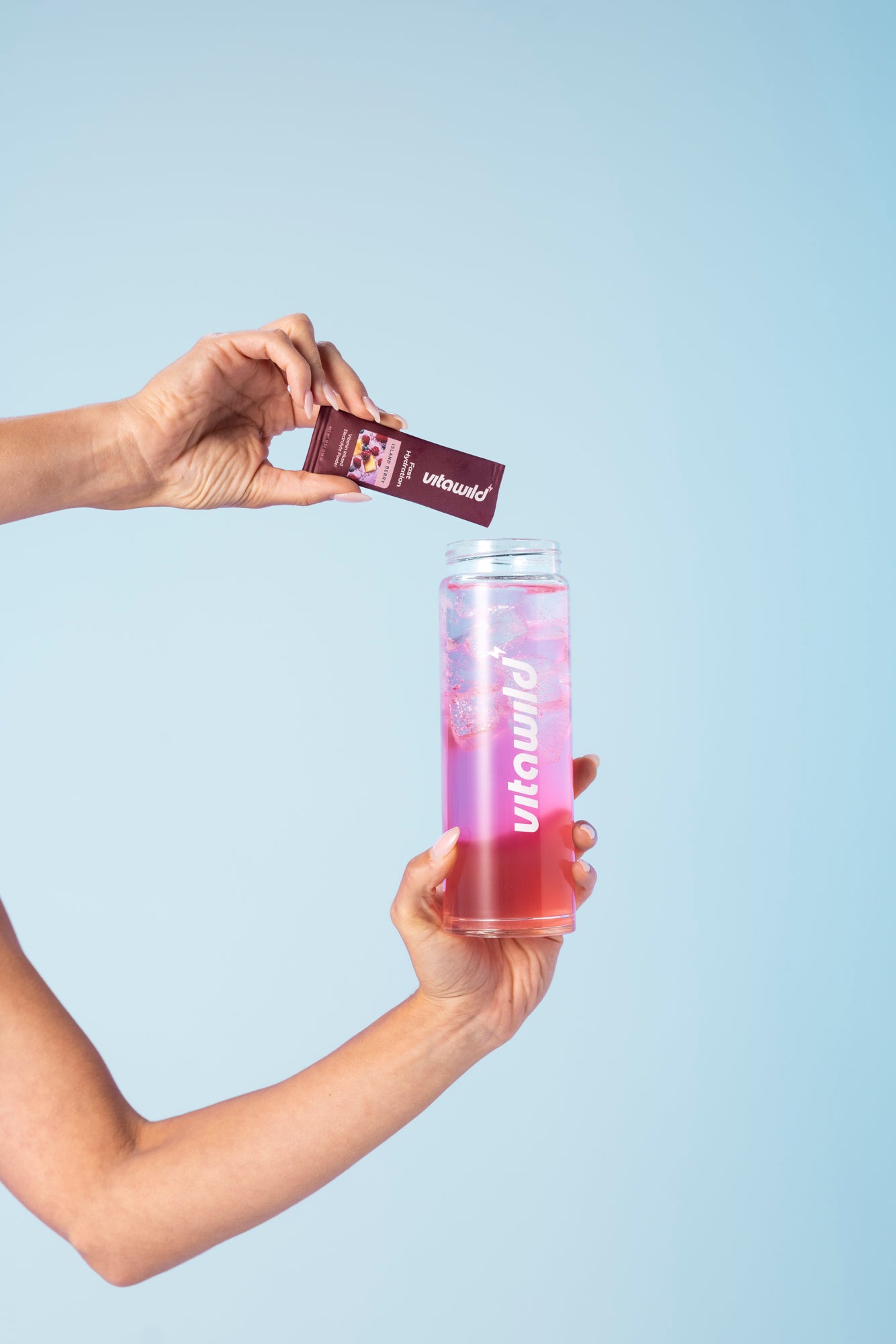
VitaWild was built with exactly this profile in mind. Each stick delivers 800mg potassium citrate, 80mg magnesium from magnesium citrate and the trace mineral complex, 450mg sodium, and 2,400 IU Vitamin D3 — the form the body converts most efficiently. Calcium comes from Aquamin® F, a marine-sourced complex with demonstrated bioavailability. Because aging kidneys lose trace minerals more readily, VitaWild also includes 84+ trace minerals via ConcenTrace® — the kind of broad mineral support food and plain water don't provide. Zero grams of added sugar means no contribution to the blood sugar swings that often accompany this decade.
One stick in the morning handles the most critical replenishment window. A second mid-afternoon — rather than a third cup of coffee — addresses the hours when cellular dehydration and cognitive drag tend to peak.
A few other things worth doing: get your Vitamin D levels tested if fatigue and mood symptoms are significant, ask your doctor about an electrolyte panel if you're experiencing frequent cramps or disrupted sleep, and sip consistently throughout the day rather than catching up in the evening.
This Is Addressable
The afternoon wall, the morning stiffness that takes twenty minutes to shake off, the brain fog that makes you reach for your third cup of coffee before noon — a lot of it isn't just aging. It's your aging body's changed relationship with water and minerals, and it responds well to targeted adjustments.
You've already done the hard part by paying attention to your health. The missing piece tends to be smaller than people expect: not a complete overhaul, but a smarter approach to what's actually in the water you're already drinking.
Hydration after 40 is still simple. It's just not as simple as drinking more.
Ready to feel the difference?
Try VitaWild — Save 55% TodayFree shipping · 90-day money-back guarantee · Cancel anytime


