

Hydration Journal
Breastfeeding and Hydration: Why You're So Much Thirstier Than You Expected

Edited October 5, 2026
It's 3am. Your baby latches on and within thirty seconds your mouth goes completely dry, your throat tightens, and all you can think about — despite the sleep deprivation, despite the sore nipples, despite the fact that you need to be up again in two hours — is water. Except your glass is already empty, it's across the room, and you're not going to put the baby down to get it.
Nobody warned you it would feel like this. Nobody told you that nursing thirst is its own specific, relentless category of thirst. You're not imagining it, and you're not being dramatic. Your body is doing something genuinely extraordinary, and the hydration demand that comes with it is just as real.
Why Breastfeeding Makes You So Thirsty
There's a cleaner way to hydrate.
Try VitaWild — Save 55% TodayFree shipping · 90-day money-back guarantee · Cancel anytime
The numbers are more significant than most people expect. Producing breast milk requires approximately 25 to 30 additional ounces of water per day — that's roughly 750 to 900ml on top of the baseline hydration your body needs for everything else it does. In the early weeks, when you may be nursing eight to twelve times in a 24-hour period, the cumulative demand adds up fast. Most new mothers are already behind on fluids before the first morning feed even begins.
But there's something more specific happening during the feed itself. Prolactin — the hormone responsible for milk production — also triggers a thirst response in the brain. This is called "nursing thirst" or "milk ejection reflex thirst," and it's a documented physiological phenomenon. Your body is essentially wiring the sensation of thirst to the act of feeding, which is actually a useful design: it's meant to prompt you to drink so you can keep producing. The problem is that the signal is strongest in the middle of the feed, when you're trapped on the couch in the dark with an empty glass.
Understanding that this is a hormone-driven response — not a sign something is wrong, not anxiety, not dehydration alone — can make it feel more manageable. Your body is working. It's asking for something specific.
The Electrolytes You're Losing
Water is only part of the equation. Breast milk itself contains sodium, potassium, magnesium, calcium, and zinc — all pulled from the mother's reserves with every feed. Your body's first priority is producing adequate milk for your baby, which means those minerals are drawn from whatever stores you have. If your reserves are already low (and they often are, for reasons we'll get to), the math catches up with you.
Electrolytes are what allow your cells to actually use the water you're drinking. Without adequate sodium and potassium, fluid doesn't move efficiently across cell membranes. You can drink a reasonable amount of water and still feel off — foggy, tired, lightheaded, or inexplicably thirsty — because plain water doesn't restore what the mineral loss has taken.
Why Postpartum Depletion Compounds Everything
Pregnancy and labor are nutritionally expensive. By the time most women give birth, stores of iron, zinc, B12, Vitamin D, and magnesium have already been drawn down significantly to support fetal development. Many new mothers never fully replenish before breastfeeding begins, which means nursing starts on a deficit — and that deficit deepens with every feed.
Vitamin D is a particular concern. Breast milk is naturally low in Vitamin D, generally not sufficient to meet infant needs on its own. The American Academy of Pediatrics recommends that breastfed infants receive 400 IU of Vitamin D daily as a supplement. But the mother's own Vitamin D status is frequently depleted postpartum as well, and low Vitamin D has been associated with postpartum mood changes in some research. It's worth raising with your OB or midwife, especially in the first several months.
B6 is another nutrient worth knowing about. B6 is involved in the synthesis of serotonin, and depletion — which is common in the postpartum period — may be associated with mood instability and irritability. This is not a substitute for professional evaluation if you're experiencing postpartum depression or anxiety, but it's a reminder that what you're eating and absorbing has real downstream effects on how you feel.
Choline doesn't get nearly enough attention. It passes through breast milk and plays a meaningful role in infant brain development. The recommended daily intake for breastfeeding women is 550mg — higher than for non-pregnant adults — and most standard prenatal vitamins don't come close to covering it.
Practical Hydration Habits for the Nursing Period
The single most useful habit is this: drink a full glass of water at every feed. Use the latch as your cue. You're going to be sitting there anyway — make it a non-negotiable part of the ritual. Keep a large water bottle at every nursing station in the house (by the bed, on the couch, wherever you feed during the day). Fill them before you go to sleep. You should never have to get up to get water mid-feed.
Hydrate before bed, not just during the day. The overnight feeds pull from whatever you went to sleep with, and waking up already behind on fluids makes the 3am thirst that much more brutal.
In warmer months — or if you're running, sweating, or spending time outside — plain water is often not enough to keep up with the combined demand of nursing and heat. This is when electrolytes become genuinely important rather than just a nice-to-have. Your sweat carries sodium and potassium that your breast milk is already drawing on, and the gap between what you need and what water provides widens considerably.
If you notice persistent fatigue beyond the expected new-parent exhaustion, unusual brain fog, muscle cramps, or mood shifts that feel out of proportion, it's worth asking your healthcare provider about your nutrient status — a simple panel can show where your levels actually are.
The Challenge of Finding Something You Feel Good About

Here's where nursing mothers run into a specific problem. You are, rightly, more attentive to what goes into your body at this stage than at almost any other point in your life. You're reading labels. You're skeptical. You know that what you consume passes through to your baby, and that instinct to protect is appropriate.
Most electrolyte products on the market contain artificial dyes, artificial sweeteners, or added sugar in amounts that don't feel right for this stage. Finding something that covers the nutritional gaps — real electrolytes, Vitamin D, B-vitamins, no synthetic anything — is harder than it should be.
What to Look for in a Nursing-Friendly Electrolyte
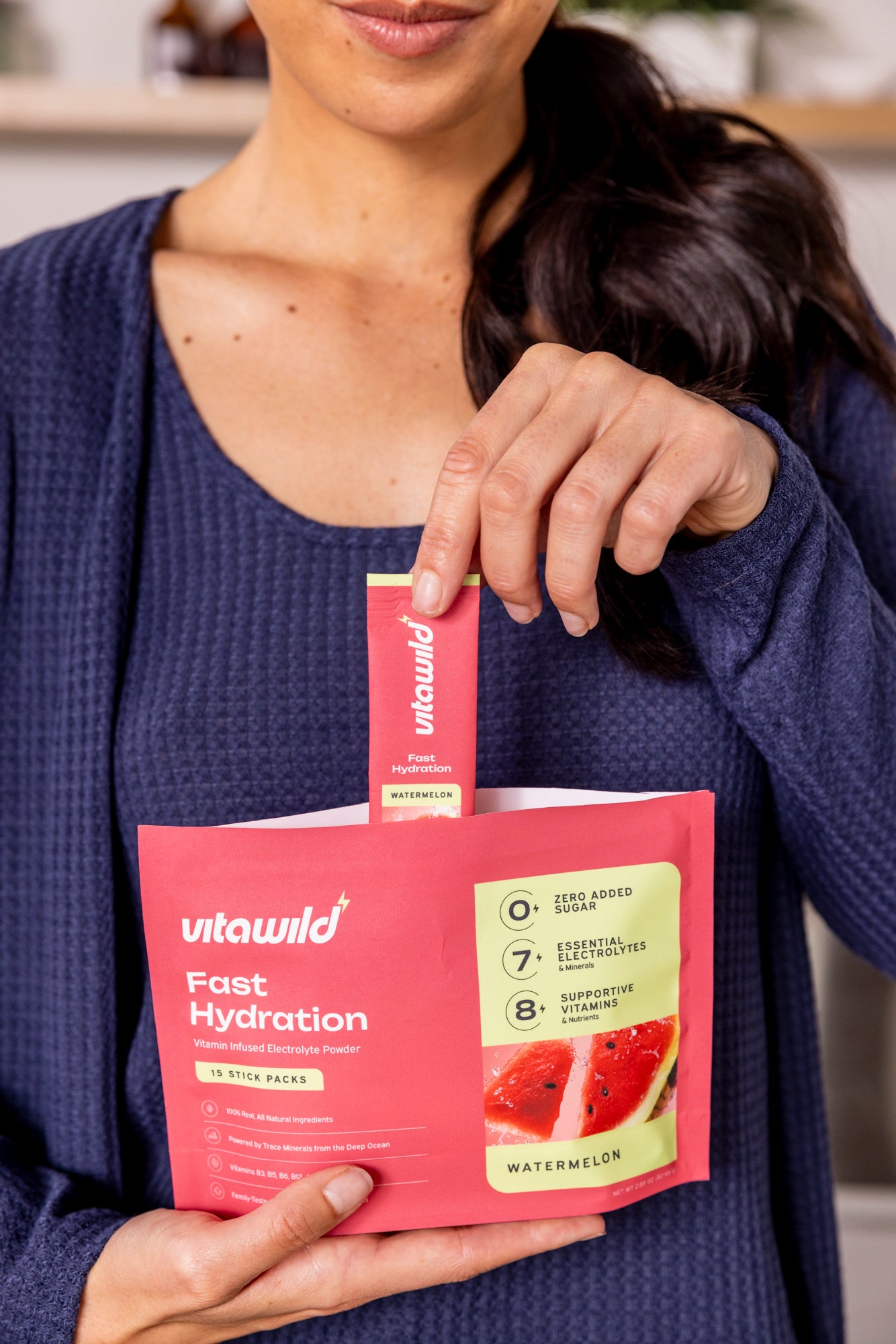
At this life stage, the ingredient list matters as much as the electrolyte content. What you're looking for: zero artificial dyes and flavors, no added sugar (you're managing postpartum weight alongside everything else), meaningful sodium and potassium levels rather than token amounts, and ideally Vitamin D and B-vitamins to address the postpartum gaps water can't touch.
VitaWild was formulated with exactly this standard. There's 0g of added sugar and no artificial colors, flavors, or preservatives — the label passes the "would I feel comfortable with this going to my baby" test that every nursing mother runs instinctively. The electrolyte profile is substantive: 450mg sodium, 800mg potassium, and 80mg magnesium per serving. Vitamin D comes in at 2,400 IU to support postpartum mood and bone density. The B-complex — including B6 and B12 — covers energy and nervous system support. And there's 60mg of choline per serving, which passes through milk and supports infant brain development in ways most electrolyte products never consider.
For nursing mothers who prefer a whole-food option, coconut water provides some potassium and is gentle on the stomach — though its electrolyte levels are lower and it doesn't address the vitamin gaps. BodyArmor Lyte is lower in sugar than many sports drinks but does contain artificial sweeteners, which some nursing mothers prefer to avoid. Plain water plus a clean electrolyte salt works too if you want to keep things minimal.
VitaWild stick packs fit in a nursing bag, a diaper bag, or the pocket of whatever you're wearing at 3am. One in each room where you feed makes the habit easy. If you're already taking a postpartum multivitamin or other supplements, check with your OB or midwife before adding anything new — this is a stage of life where you deserve personalized guidance.
The thirst is real. The depletion is real. Taking care of yourself isn't separate from taking care of your baby — it's the same project.
Keep a glass of water and a stick pack at every nursing station. Drink at every feed. You don't have to do this perfectly; you just have to do it consistently.
Ready to feel the difference?
Try VitaWild — Save 55% TodayFree shipping · 90-day money-back guarantee · Cancel anytime


